
AH Mobile Tyre Fitting provides 24/7 mobile tyres in Leeds and tyre replacement throughout Yorkshire. The guidance below helps you make a safer decision before professional assistance arrives.
The quick answer
On a normal tyre that has gone flat, the honest answer is: don't drive on it at all, beyond getting safely out of traffic. Driving on a flat destroys the tyre, can damage the wheel and other parts of the car, and makes the car harder to control. Run-flat tyres are different. Most manufacturers recommend no more than about 50 miles at up to 50mph after a puncture, but limits vary, so check your vehicle handbook and the tyre maker's guidance. A space-saver spare is a temporary wheel, usually limited to 50mph, meant to get you to a tyre specialist rather than carry on your journey. In every case, the aim is to get the tyre properly sorted as soon as possible.
Why a normal flat tyre shouldn't be driven on
A standard tyre relies on air pressure to hold its shape and carry the weight of the car. When the air goes, the sidewalls collapse and the wheel rim ends up sitting on a thin layer of folded rubber. That changes how the car behaves. Steering gets heavy, the car pulls towards the flat side, and braking becomes less predictable. At speed, a collapsed tyre can come off the rim altogether. The only driving you should do on a flat is the minimum needed to get out of danger: off a live lane, onto a hard shoulder or emergency area, or into a safe spot off the road. Slowly, with hazard lights on.
What driving flat does to your car
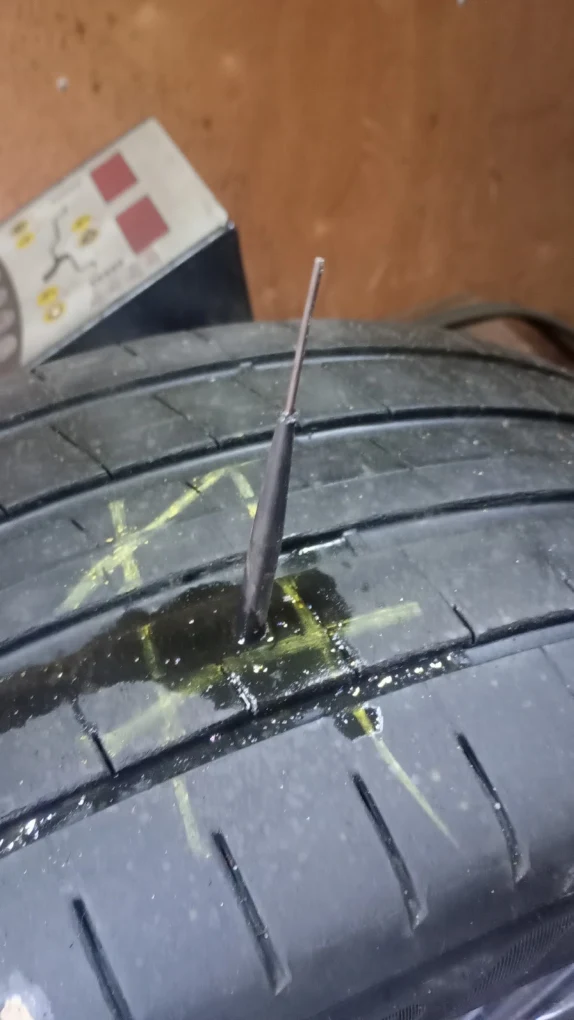
Even a short distance on a flat can turn a cheap fix into a bigger bill. The tyre's sidewalls get pinched between the rim and the road, overheat and break down from the inside. Under BS AU 159, a tyre that has been used flat or badly underinflated can't be repaired, so a simple nail can become a new tyre. The wheel takes a beating too. Rims can be bent, cracked or scraped, especially alloys. Suspension components and brake parts can also be damaged if the rim hits the road surface or a kerb. There's also the safety side. Losing control on a flat puts you, your passengers and other road users at risk. Stopping early is always cheaper.
Getting off the road safely
If you feel a puncture, grip the wheel firmly, ease off the accelerator and avoid harsh braking. Indicate and move to a safe place to stop. On a motorway, aim for the hard shoulder or an emergency area. Once stopped, put your hazard lights on, get everyone out on the side away from traffic if it's safe, and wait behind the barrier. If you can't get out of a live lane, stay in the car with your seatbelt on and hazard lights on, and call 999 straight away. AH Mobile Tyre Fitting can attend hard shoulders and emergency areas, but if you're stopped in a live lane, the lane must be made safe first.
How run-flat tyres work
Run-flat tyres have reinforced, stiffer sidewalls that can support the weight of the car for a limited distance after losing air. Instead of collapsing, the tyre keeps enough shape for you to drive on carefully to a safe place. You can usually identify them from markings on the sidewall, such as RFT or SSR, or from other manufacturer-specific labels. Many cars fitted with run-flats from new don't carry a spare wheel at all. A car using run-flats must have a working tyre pressure monitoring system. Because the tyre doesn't sag much when it loses pressure, the warning light on the dashboard may be the only sign you have that something's wrong.
How far on a run-flat?
The common guidance is no more than 50 miles at no more than 50mph after a puncture. Some premium run-flats are rated for longer distances at reduced speeds, but you shouldn't assume yours is one of them. The figure depends on the tyre, the car and the load you're carrying. A heavily loaded car on a hot day puts more strain on a deflated tyre than a lightly loaded one in cool weather. Check your vehicle handbook and the tyre manufacturer's guidance so you know your limit before you need it. Treat that distance as the maximum to reach a safe place for help, not a target to finish your journey.
After driving on a run-flat
Once a run-flat has been driven deflated, expect to replace it. The reinforced sidewalls can hide internal damage, so it's very hard to be confident the tyre is sound. Most tyre specialists won't repair run-flats, and the usual advice is replacement. Don't mix run-flats with standard tyres on your car. The two behave differently, and mixing them affects handling and safety. If your car came on run-flats, the replacement should normally be a run-flat of the correct size, load index and speed rating. Run-flats aren't available in every size, and not every supplier keeps them in stock, so it's worth calling ahead with your tyre size.
Space-saver spares
Many cars carry a space-saver spare rather than a full-size wheel. These are narrower than standard wheels and designed only for temporary use to get you to a place of repair. Speed is usually restricted to 50mph, and the exact limit is printed on the wheel or in your handbook. Some cars specify whether the space-saver can go on the front or rear. Handling and braking will feel different, so drive gently. There's no set legal distance limit, but a space-saver isn't for long journeys. If you're towing a caravan or trailer, drive straight to a tyre specialist. Check the space-saver's pressure every so often too, because they're easily forgotten until needed.
Sealant and inflator kits
Some cars come with a tyre sealant and inflator kit instead of a spare. These can seal some small punctures in the tread and get you moving again, but they won't fix sidewall damage, large holes or a tyre that's come off the rim. Follow the kit's instructions and its speed and distance limits, which are usually printed on the kit or the sticker it comes with. Treat it as a way to reach help, not a repair. If you've used a sealant kit, tell your tyre fitter before they start work. They need to know what's inside the tyre so they can inspect it properly and decide whether it can be repaired or needs replacing.
Warning signs to watch for
Not every puncture is a sudden bang. Slow punctures are common and easy to miss until the tyre is very low. Watch for the car pulling to one side, the steering feeling heavy or vague, a rumbling or flapping noise, or a bouncy, uneven ride. On cars with a tyre pressure monitoring system, take a warning light seriously and check the tyres as soon as you safely can. If one tyre needs air more often than the others, there's probably a slow puncture. Getting it looked at early often means a BS AU 159 repair instead of a new tyre, because the tyre hasn't been driven low for long.
Let AH come to you instead
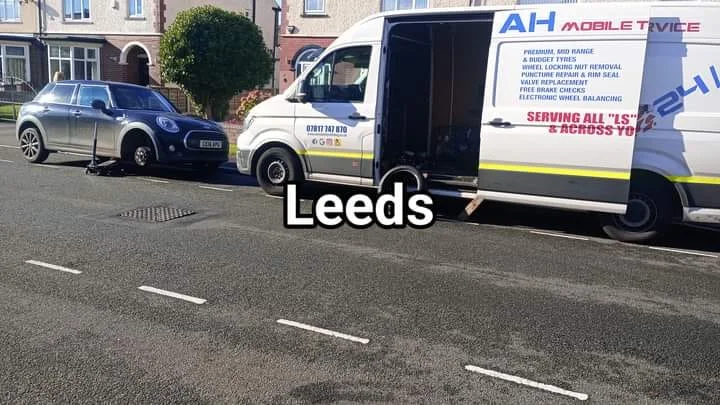
The best way to avoid driving on a flat is to have the tyre sorted where the car is. AH Mobile Tyre Fitting attends homes, workplaces, services, motorway hard shoulders and emergency areas across Leeds and Yorkshire, 24 hours a day. We inspect first, carry out a BS AU 159 puncture repair if it's safe, and replace the tyre only if it isn't. New and part-worn tyres are available in budget, mid-range and premium options, with free electronic wheel balancing on every fitted tyre. You'll agree the price on the phone before the van sets off and get a real arrival time. Call 07817 747870.
Official safety sources
This article was checked against current official guidance. Always follow instructions from the emergency services, police, traffic officers or road operator at the scene.
Need help with a tyre now?
Call with your location, registration and sidewall tyre size.
Call 07817 747870